
 | ||||||||||||
 The higher functions of visual perception process this initial visual stimuli in a highly sophisticated way. So much so, that if we were in an environment that was actually upside down, eventually the brain would start to see it in a way that made more rational sense, and we would begin to see new upside-down world as right-side up. Scientists and artists love to play with optical illusions and tricks which play with the edges of how our brain compute visual information.  “The movement of Op Art was dominated by painting and characterized by an innovative use of pattern, structure and color, which transfigured and transcended the two-dimensional plane.” p.133 from Optic Nerve - Perceptual Art of the 1960s by Joe Houston.
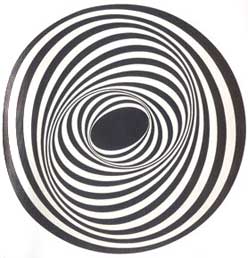
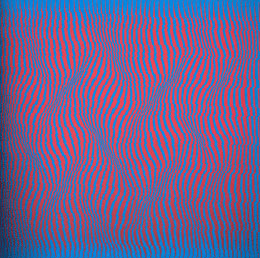
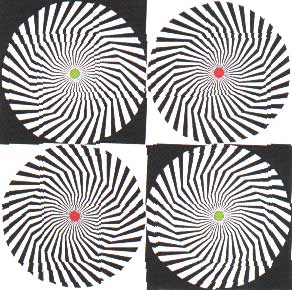
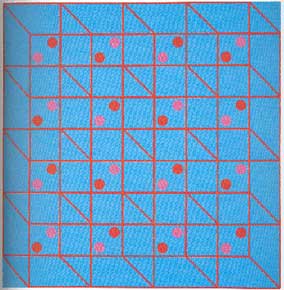
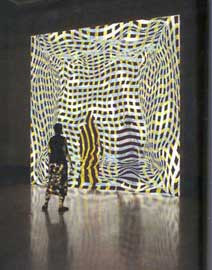
Op art implies movement within its dynamic perceptual interaction with a viewer. Moire patterns create real and imagined spatial effects, subverting the 2D planar structure of a painting without the use of traditional perspective. Its aim calls attention to internal perceptual processes instead of pointing outward to experiences of the external world.
Joe Houston credits the historical legacy of Op Art as being significant “not in any pictorial “style”, but in its emphatic shift from object to experience. The relocation of the aesthetic experience to the eye/body of the viewer inspired unconventional forms of viewer-centered art, including light projection, multimedia, installation, and video.” p. 157 Optic Nerve - Perceptual Art by Joe Houston.
|

[page 1] [page 2] [page 3] [page 4]
Return to main Page