
 |
 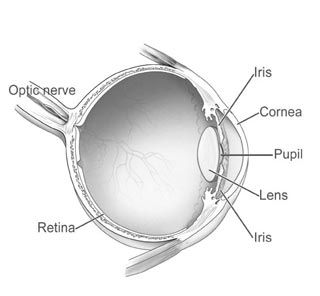 The early visual system is composed primarily of the eye and the optical nerve track. Light enters the eye through the pupil, refracting through the lens and hitting the retina.  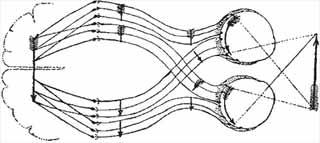 Ramon y Cajal, Histology of the Nervous System, 1909-1911 Once the image has been captured by the retina, the information travels along the optical nerve track. Optical nerves from each eye connect to both hemispheres of the brain, reproducing two slightly different perspectives on the same object. These images are then reconfigured by the brain into a single, 3-dimensional image. The following is taken directly from: Virtual Retinal Display (VRD)Technology  One of the 125 million nerve cells in the retina of each eye that emit electrical signals when activated by light of a particular wavelength. There are two types of photoreceptor cells in vertebrates: rods, used in low light, and cones, which respond in brighter light and to color. 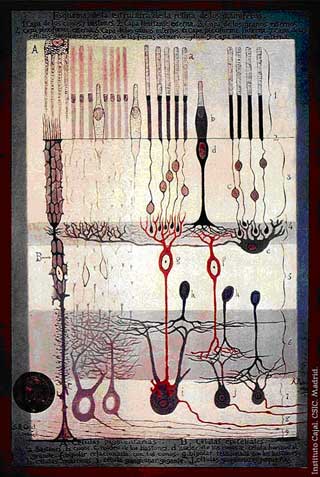 The intricate layers and connections of nerve cells in the retina were drawn by the famed Spanish anatomist Santiago Ramon y Cajal around 1900. Rod (a) and cone (b) cells are at the top. Optic nerve fibers leading to the brain may be seen at bottom right. " - article on the US Navy (IVRD) project, a project in connection with the University of Washington. See information here. |
[page 1] [page 2] [page 3] [page 4]
Return to main Page